WITH O'CONNOR RETIRING, RHENQUIST AMAZED
TO LEARN RETIREMENT IS AN OPTION
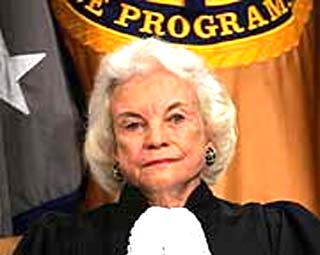
An unrelated picture of the partially melted wax head of founding father and first United States President George
Washington.
WASHINGTON--
Sandra Day O'Connor's sudden resignation last month from the Supreme Court surprised
Chief Justice William Rehnquist. Rehnquist said he was amazed to learn retirement is an
option. "Hell, if I would have known you could just up and quit I would have done so
years ago." Rehnquist continued, "I could just take these four golden bars on my robe's
sleeves and sew them on my sweat suit at home. That would be great, no more trying to
TiVo Matlock and Family Ties re-runs and having to listen to that wind-bag Clarence
Thomas talk to all the women in a five mile radius about Coca-Cola and pubic hair. And
don't get me started on that S.O.B. Scalia."
O'Connor's resignation signals the departure of a pioneering justice who was the most
influential member of a divided court. It also ignites a political firestorm over her
successor, and gives President Bush a chance to make a lasting imprint on the bench.
In a statement released by the court, O'Connor, 75, said she was leaving in part to spend
more time with her husband. John O'Connor, also 75, has been suffering from
Alzheimer's disease and incontinence unrelated to the disease. Her resignation creates
the first opening on the Supreme Court in 11 years, the bench's longest period without a
departure since 1812-1823. The former Arizona state senator was at the ideological
center of the court and was the court's equilibrium, resisting moves by her colleagues to
move the court too much to the left or to the right.
To the disappointment of many conservative Republicans, hypocritical politicians are
falling out of favor, and O'Connor cast key votes protecting abortion rights, an issue that
is certain to be a key point in the Senate confirmation hearings for whoever Bush chooses
as her replacement. In disputes over the separation of church and state, O'Connor
generally supported limited government mingling with religion. She also took a lead role
as the Rehnquist court boosted states' rights and curtailed congressional intervention in
the affairs of local governments.
She often was criticized - by conservative Justice Antonin Scalia, among others - for
seeming to have no hard-and-fast rules on the law and for compromising too much,
compared with Scalia who is widely known to consult a Magic Eight Ball in making all
of his decisions. But O'Connor, the only member of the current court who ever held
elective office, favored real government action to come from elected legislators, not
through judicial activism.
